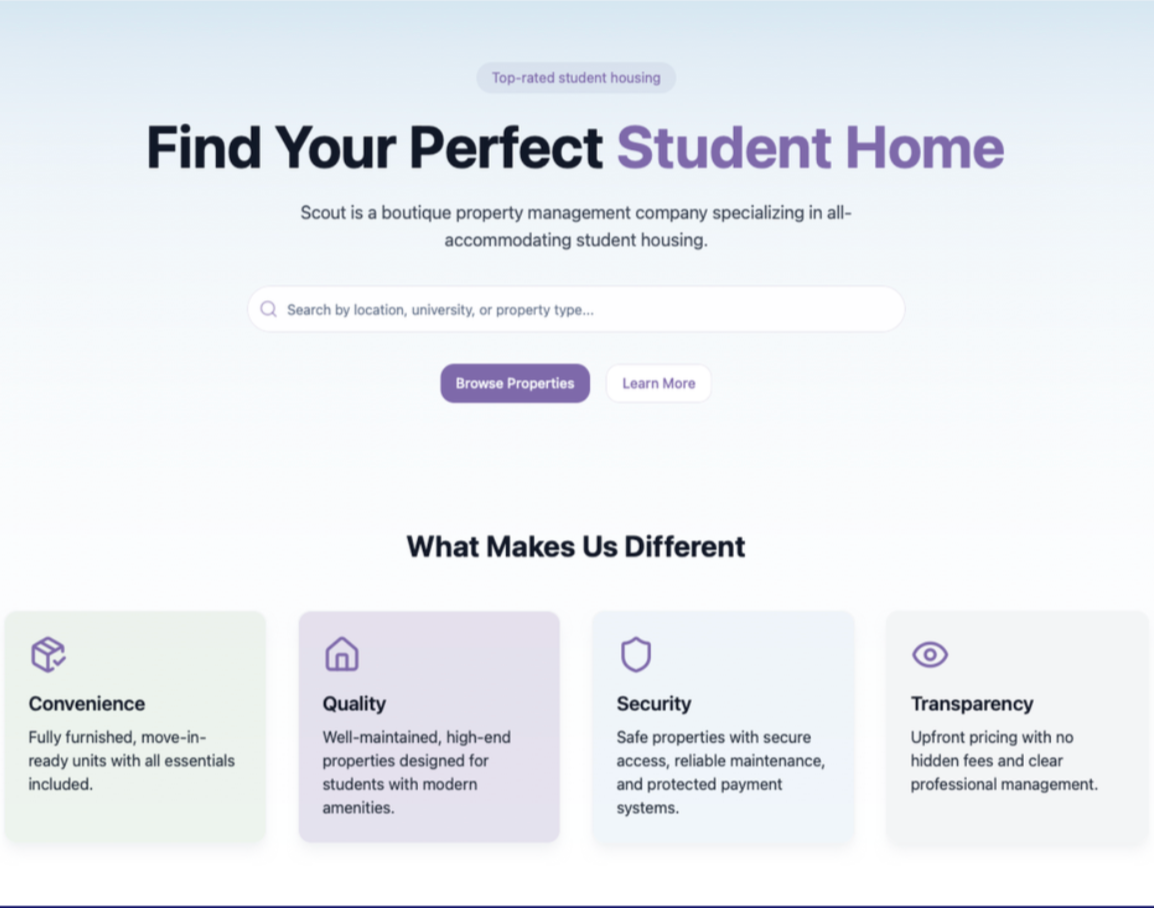
Keystone Homes explores how product strategy and operations can improve the off-campus student housing experience by replacing fragmented, unreliable rentals with a standardized, move-in-ready model.
Off-campus student housing is often frustrating, opaque, and poorly managed. Students typically navigate scattered listings, inconsistent pricing, unclear lease terms, and apartments that vary widely in quality and maintenance. For international students and first-time renters especially, the process can feel risky and overwhelming. Keystone Homes began with a simple question: what would student housing look like if it were designed like a product rather than treated as a fragmented real estate market?
The project focused on designing a student-first housing model that simplifies discovery, move-in, and day-to-day living through standardized, move-in-ready apartments and reliable management. Through user research, market analysis, and go-to-market planning, Keystone reframed off-campus housing not as a fragmented real estate problem, but as a product and service experience that could be intentionally designed end to end.
I co-founded Keystone Homes with two others as the Product and Marketing Lead, where I led customer discovery, product definition, and go-to-market strategy for a student-first housing company. We are currently fundraising to acquire our first property in the Tufts area, validating demand, pricing, and operational assumptions before purchasing and scaling the model.
Keystone Homes
-
In our research, I found that off-campus student housing often fails not because of price alone, but because of inconsistency, poor quality, and operational friction. Students frequently face outdated units, unreliable landlords, hidden setup costs, and stressful move-in logistics, especially those new to the area or relocating internationally.
From the student perspective, the housing process is fragmented and time-consuming, pulling focus away from academics and campus life. From the parent perspective, the lack of transparency, safety assurances, and professional management creates anxiety around trust and reliability. At the same time, many small landlords struggle with tenant turnover, maintenance burden, and inconsistent rental income.
From a product standpoint, I saw this as a multi-sided problem. Improving student housing required designing not just better apartments, but a cohesive system that aligned student convenience, parental trust, and landlord stability into a single, standardized experience.
-
To validate the problem and solution, I contributed to extensive user and market research across students, parents, and landlords. We conducted 90+ interviews and 70+ survey responses, focusing on housing quality, willingness to pay for convenience, safety concerns, and operational pain points.
Student interviews revealed a strong willingness to pay a premium for fully furnished, move-in-ready apartments that eliminate setup work, utility coordination, and maintenance uncertainty. International and out-of-state students surfaced particularly acute pain around remote housing searches, scams, and unreliable listings.
Parents emerged as key decision-makers, prioritizing safety, transparency, and professional management. Research showed that parents were willing to pay more for housing that reduced risk and stress while supporting academic success. On the supply side, landlord interviews highlighted openness to master lease models that offer guaranteed rent, reduced operational burden, and property value improvements.
These insights shaped Keystone’s value proposition and pricing strategy, validating that convenience, trust, and reliability, not just square footage,were the core drivers of demand.
-
Based on these insights, I worked on defining Keystone Homes as a turnkey housing product, not just a real estate offering. Product strategy focused on standardizing quality, simplifying onboarding, and reducing friction at every stage of the housing lifecycle, from discovery and leasing to move-in, living, and move-out.
Key strategic decisions included:
Designing apartments as fully furnished, move-in-ready units with utilities and Wi-Fi set up in advance
Treating safety, maintenance response time, and cleanliness as core product features, not operational afterthoughts
Implementing a hybrid business model combining property acquisition and master leases to balance control, speed, and capital efficiency
Building trust through transparent pricing, digital leasing, and parent-accessible information
I also worked on go-to-market planning, including early adopter targeting at Tufts, partnerships with university housing offices, student ambassador programs, and parent-focused messaging. These efforts framed Keystone not as another landlord, but as a branded, student-first housing experience that parents could trust and students could rely on.
Together, this work demonstrated how product thinking can be applied to a highly operational domain, using research, systems design, and execution to turn a traditionally fragmented experience into a cohesive, scalable product.
Aetherion explores how product design can make climate action more credible and accessible by addressing trust and transparency failures in carbon markets.
The project focused on designing a two-sided marketplace connecting farmers and corporate sustainability teams, each making high-stakes decisions with limited clarity. Through user-centered research, system-level product thinking, and early prototyping, Aetherion reframed the carbon marketplace not as a transactional problem, but as an information and trust problem, one that product design could meaningfully address.
I worked on Aetherion as part of my MSIM fall sprint, serving as Product Lead and COO, where I focused on designing a two-sided marketplace connecting farmers and corporate sustainability teams, two user groups making high-stakes decisions with limited clarity and asymmetric information.
Aetherion
-
Carbon markets struggle not because of a lack of demand, but because of how trust, information, and accountability are structured. Participants are often required to make high-stakes decisions based on opaque processes, abstract data, and third-party assurances that are difficult to evaluate.
For farmers, participation involves unfamiliar terminology, long timelines, and uncertainty around how regenerative practices translate into verified value. For corporate sustainability teams, the challenge lies in evaluating credit credibility, managing reputational risk, and justifying purchasing decisions internally.
From a product perspective, this created a core challenge: trust could not be solved through messaging or surface-level transparency alone. The system itself needed to make complex processes legible, align incentives across stakeholders, and support confident decision-making without requiring users to become domain experts.
-
To understand where carbon markets break down, the team conducted user-centered research across the full ecosystem, including farmers, corporate sustainability leaders, and domain experts. Interviews focused on how participants currently engage with carbon programs, where confusion or mistrust arises, and what information is required to make confident decisions at each stage of the process.
Farmer interviews revealed hesitation driven less by lack of interest and more by uncertainty—unclear expectations, delayed value realization, and limited visibility into how on-farm practices translate into verified outcomes. These insights highlighted the need for clearer feedback loops and transparent representations of progress over time.
Corporate stakeholders emphasized credibility and traceability. Sustainability teams struggled to evaluate credit quality, compare projects, and communicate legitimacy internally. Trust was closely tied to visibility into data sources, methodologies, and verification processes rather than aggregated metrics alone.
Rather than validating preconceived solutions, these insights actively reshaped the product definition. The research reframed the marketplace from a simple exchange of credits into a decision-support system where clarity, interpretability, and trust were the core requirements.
-
Research findings informed Aetherion’s product strategy at a system level. The platform was designed as an information system first, rather than a transactional marketplace, prioritizing transparency, traceability, and clear information flows across stakeholders.
For farmers, this meant designing participation around clarity and feedback rather than complexity. Product assumptions emphasized onboarding simplicity, progress visibility, and clear explanations of how regenerative practices contribute to verified outcomes over time.
For corporate users, the strategy focused on surfacing verification logic and traceability rather than abstracting it away. Product decisions centered on structuring and presenting data so that credit quality could be evaluated, compared, and justified internally with confidence.
Early interface explorations in Figma and a high-level interactive prototype built in Lovable were used as thinking tools to pressure-test assumptions about information hierarchy, trust, and user understanding across both sides of the marketplace. These artifacts were not final designs, but mechanisms for reasoning through complex interactions and aligning product strategy with user needs.
Nightly explores how product design and agile execution can simplify nightlife discovery and group planning for students and young professionals.
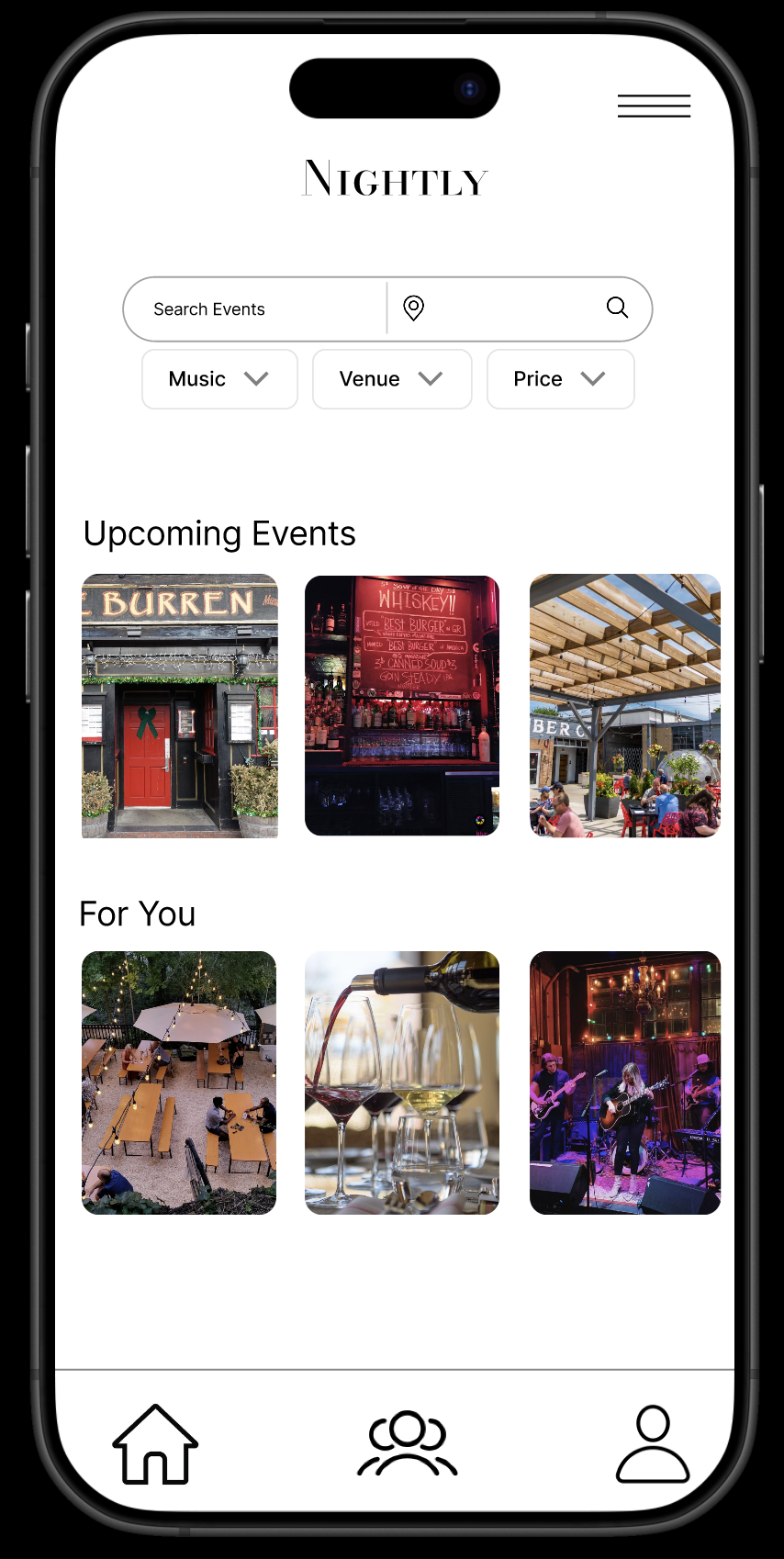
The project focused on building an MVP that centralizes event discovery, real-time updates, and social coordination into a single mobile experience, addressing fragmented tools and planning friction that make going out harder than it should be.
I worked on Nightly as part of a hands-on product and operations course, where we used lean, agile methodologies to design, scope, and deliver a fully realized MVP through iterative sprints, retrospectives, and continuous user feedback. The project emphasized practical execution over polish, with a strong focus on customer-centric design, decision-making under uncertainty, and cross-functional collaboration.
Nightly - Product Execution & Agile Delivery
-
Through early research and validation, I identified that nightlife planning breaks down not because of a lack of events, but because information and coordination are scattered across platforms. Users rely heavily on social media, word of mouth, and multiple ticketing tools, yet still lack real-time insight into crowd size, cover fees, safety, or whether friends are attending.
Group planning emerged as a major friction point. Even when users find events, coordinating attendance, aligning preferences, and making decisions together adds unnecessary complexity. These challenges disproportionately affect students and Gen Z users, who prioritize social experiences but lack a single tool designed around how they actually plan nights out.
From a product perspective, this reframed the problem as one of aggregation and coordination, not content creation. The opportunity lay in designing a centralized experience that combines discovery, real-time insight, and social planning into a single, intuitive flow.
-
Nightly was built using lean software development principles and Scrum-based agile execution, with an emphasis on learning quickly and delivering value in small increments. I worked through the full agile lifecycle, including user story mapping, backlog prioritization, sprint planning, estimation, sprint reviews, and retrospectives.
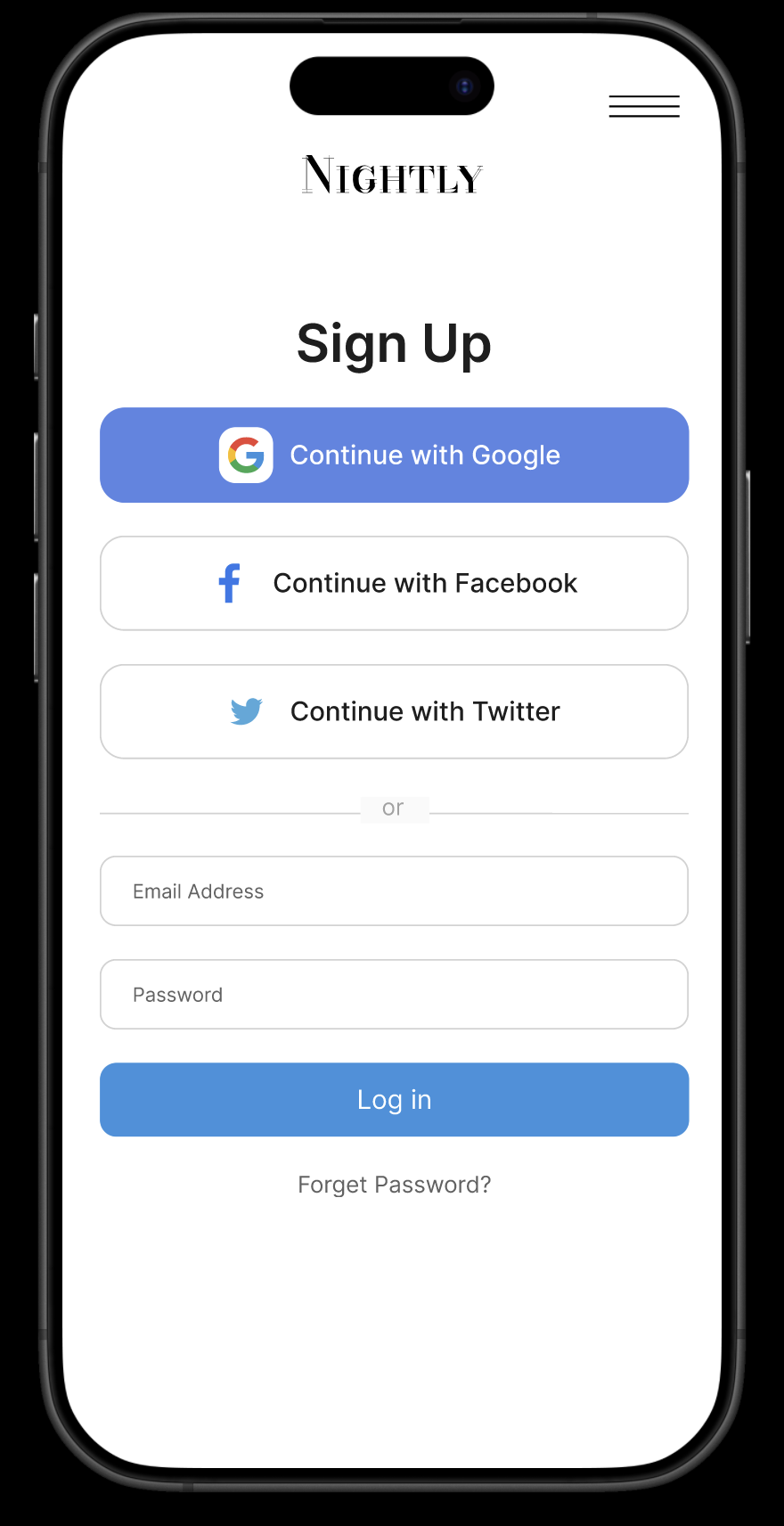
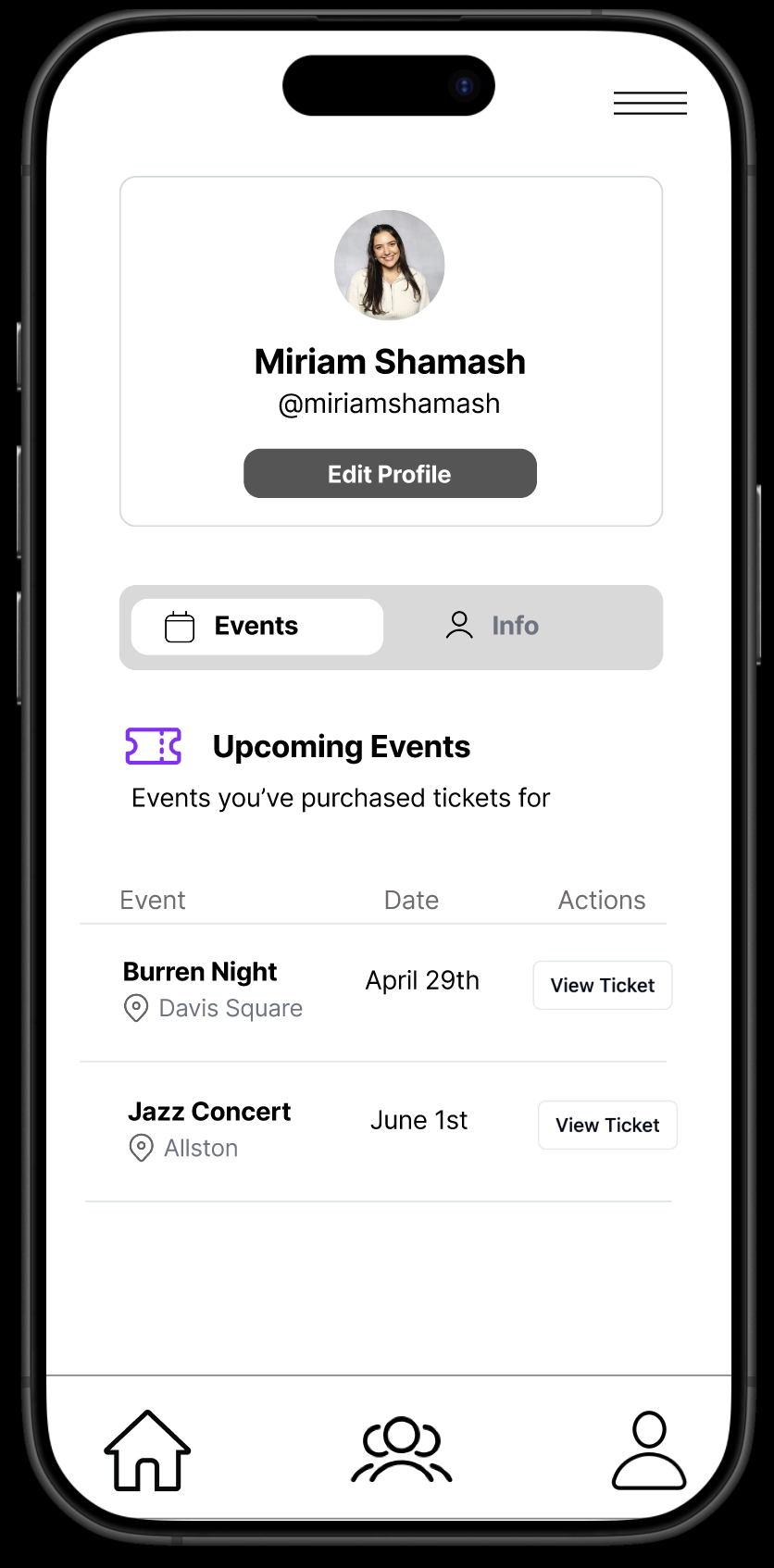
We scoped the MVP intentionally, focusing on core workflows such as account creation, preference-based event discovery, ticket purchasing, and friend-based coordination. Each sprint was designed to test assumptions, reduce risk, and validate whether features meaningfully improved the user experience rather than expanding scope prematurely.
Throughout the process, we treated agile ceremonies as decision-making tools rather than formalities. Retrospectives helped surface blockers and improve team velocity, while continuous prioritization ensured that development effort stayed aligned with user needs and learning goals.
-
A key component of this project was learning how to build and operate an MVP efficiently, both in terms of product scope and execution velocity. I developed a fully fledged interactive MVP in Figma to prototype core user flows, pressure-test assumptions, and communicate product intent before engineering investment.
In parallel, I explored how AI-powered workflows could support and scale product operations. Using tools like Zapier and ChatGPT, I automated user story generation, synthesized user feedback, logged insights into shared documentation, and experimented with AI-assisted responses to inbound signals. These workflows expanded how I think about AI—not as a feature, but as an operational layer that can accelerate discovery, analysis, and execution across the product lifecycle.
This experience fundamentally changed how I approach product development. It highlighted how lean execution, agile structure, and AI-enabled tooling can work together to help small teams move faster, learn more, and stay deeply connected to user needs without increasing overhead.
For farmers, this meant designing participation around clarity and feedback rather than complexity. Product assumptions emphasized onboarding simplicity, progress visibility, and clear explanations of how regenerative practices contribute to verified outcomes over time.
For corporate users, the strategy focused on surfacing verification logic and traceability rather than abstracting it away. Product decisions centered on structuring and presenting data so that credit quality could be evaluated, compared, and justified internally with confidence.
Early interface explorations and a high-level interactive prototype built in Figma were used as thinking tools to pressure-test assumptions about information hierarchy, trust, and user understanding across both sides of the marketplace. These artifacts were not final designs, but mechanisms for reasoning through complex interactions and aligning product strategy with user needs.